

Discover

Our assessment options
These are some of the more common assessment methods, procedures, and tools we use to gather relevant information, understand your unique situation and monitor progress.
We perform a touch examination of the skin, tissues and muscles of the abdominal area at rest, with muscle activation and during simulated functional activities such as having a bowel motion.
In conjunction with your physiotherapist, we’ll decide which bladder symptoms to track and record, along with your activity level. It’s usually completed daily for several weeks.
We ask you to record your bladder frequency and urgency, the amount you pass and any leakage episodes over 48 hours. You’ll also record the time, type and amount of fluid intake.
This requires you to have a reasonably full bladder. We place an ultrasound on your lower belly to measure your bladder capacity. Following this, you’ll empty your bladder, then the ultrasound is repeated to see how much urine remains in the bladder.
You’ll record your bowel habits every day for 1 week, noting the consistency of your poo, how often you go, the urgency, any accidents and the effectiveness of emptying.
This tool measures inflammatory symptoms in your breast, such as redness, swelling, warmth, pain and skin changes. You’ll complete this with your physiotherapist at your appointment. It helps us track how your symptoms change over time and whether treatment is working.
Assessment of the genital area, including the skin, connective tissues and pelvic floor muscles (PFM), is essential for pelvic health conditions. Pelvic Health physiotherapists have very specific postgraduate training in safely and competently assessing this area of the body. There are several options for assessing the genitals, perineum and pelvic floor. Your physiotherapist will outline what information can be obtained for each, so you can make an informed decision about whether an examination is the appropriate and preferred option for you.
The options are:
- External Observation: Visual assessment of skin, tissue and muscle function
- External Examination: Assessment through external touch of the genital area and superficial muscles
- Internal Examination: Vaginal or rectal examination to assess the skin, tissues and function of the superficial and deep pelvic floor muscles
- Transperineal Ultrasound: Advanced imaging technology showing pelvic floor muscle function in real time via a sensor placed on the perineum
Consent & safety
Feeling safe is the most critical aspect of any assessment, especially when it involves an intimate body part. With a trauma-sensitive approach, your physiotherapist will discuss your readiness for an examination. We’ll make sure you understand your options and what is involved. Examination is your choice and only occurs with your consent. You can decline or withdraw your consent at any time. Please know that declining the examination won’t impact your outcome.
Using electronic kitchen scales, you’ll track your pad weight over time to monitor the progress of bladder leakage.
With a paper towel in your underwear, this functional test assesses the degree of leakage with different types of activity. This baseline measure is recorded and compared to reassessment down the track.
Pelvic organ support and prolapse assessment are included as part of a pelvic floor and perineal examination (see above). This involves looking at the tissue and muscle support of the bladder, uterus and bowel. It may involve the use of a speculum.
You will record your pelvic organ prolapse symptoms for several weeks, tracking how much they bother you and any possible contributing factors, such as your activity level.
Before your first appointment, we ask that you complete our Pelvic Health Questionnaire to provide a summary of your history, current health concerns, their impact and what matters to you. If there is a question that doesn’t apply or makes you feel uncomfortable, feel free to leave it out. We’ll explore and discuss this information further at your initial consultation. We appreciate that this questionnaire is extensive and value your time and effort in completing it.
Pelvic health conditions can have both physical and emotional components. As part of your assessment, you may be asked to complete questionnaires about your thoughts and feelings and the symptoms you're experiencing. They're specifically designed to measure factors such as sleep, stress, anxiety, mood, fear of movement and pain-worry thoughts.
This involves placing a small catheter with a balloon on the end into the lower part of your rectum. The balloon is then inflated with air to assess the sensitivity of the nerves in the area.
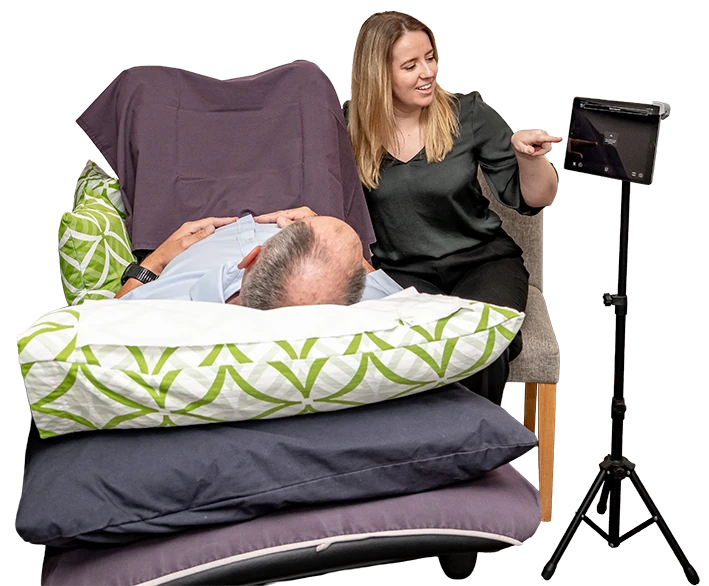
An ultrasound sensor is placed on the lower abdominal area to assess the function of your abdominal muscles. This method is also used to assess the effectiveness of bladder emptying.
This is a series of movements your physio will ask you to do that assesses how far the joints of your low back, hips and pelvis move. Using palpation and passive and resisted active movements, we can determine the tension, length and strength of the hip and pelvic muscles. There may also be other techniques that evaluate the nerves and tissues of this area.
We use an ultrasound machine to show pelvic floor muscle function in real time. The sensor is placed on the perineum, which is the area between the vagina and anus or underneath the scrotum and anus.
We’ll ask you to do a mid-stream urine sample. We then use a dip-stick test to screen for a possible infection.
For those with a vulva, examination of this area is included as part of a pelvic floor and perineal examination (see above).
Pelvic Health Matters
New name.
Same exceptional care.
Formerly known as Women’s & Men’s Health Physiotherapy, our new name reflects both what we believe in and what we do. We have an unwavering belief that pelvic health matters for everyone, at every stage of life.
Same phone number: 03 8823 8300
New email: physio@pelvichealth.com.au